|
Honouring South Africa's Humble "Veldskoen" |
(July 7, 2026, at 11h00)

![]() |
![]() |
MEDIA NOTICE
CASTLE CONTROL BOARD
7 JULY 2026
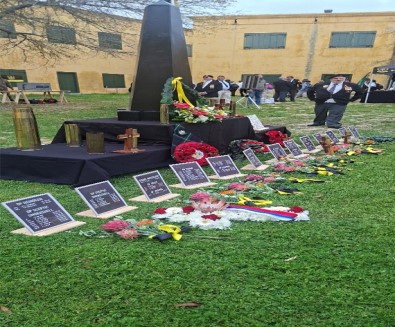
Today, July 7, 2026, at 11h00, our CEO delivered the keynote address on the occasion of honouring South Africa's humble "Veldskoen" at the Long March to Freedom Memorial Garden, Canal Walk, Century City, Cape Town.
Here are some highlights of his address
Our Master of Ceremonies, Ms Sarah Tambo; the Diplomatic Community, especially the British Consul, Mr Colin Leeman, whom I have known for quite a while; my "fans" from my hometown, Paarl; the Veldskoen team - and I want to address the little ® on your branding a bit later, ladies and gentlemen.
I am relieved to hear that the Veldskoen-team do not view themselves as the owners but as the custodians of this cultural symbol, so embedded in our being that it belongs to all of us. I also know that my forefathers, the Khoi and the San, made footwear from animal hides to carry them through the rough, thorny African veld. So, we all must proudly take ownership of this age-old cultural symbol, the humble old veldskoen (bush-shoe, to roughly translate into English).
Welcome to this Long March to Freedom-Veldskoen Partnership event, cemented with the unveiling of a plaque under the beautiful African sun. When I travelled in this morning, there was thick mist; now it is all gone, and I know where the words “mystery” and “mystique” come from!
Knowing Mr Dali Tambo by now, I thought we would unveil a shoe the size of a church today, but alas, it’s this small plaque behind me and in front of you. But here we are at this beautiful memorial garden honouring this iconic cultural symbol of strength, resistance and resilience. Clearly, the veldskoen serves as a metaphor for where we came from, where we are now, and where we are going.
In 1985, when I was a young master's student conducting research at Wupperthal, I met an older man I vividly remember as Oom Baard Valentyn, a shoemaker at the small factory in this picturesque village. At that stage, he was already contemplating how globalisation was altering life in rural Indigenous communities in South Africa. He told me about the difficulties with export markets, the materials they had to import, and so on. His story is not unlike those in Hammanskraal, Qunu, Genadendal, Enon or elsewhere in apartheid Southern Africa. I bought some shoes from Oom Baard, but they were not vellies; they were the famous Wupperthal sandals. Sadly, if Oom Baard were still alive today, he would have been devastated to see the destruction caused by the Wuppertal fire a couple of years ago.
Ladies and gentlemen, I genuinely recognise the value and power of heritage partnerships like these. A case in point is when we at the Castle celebrated its 350th anniversary in 2016 and partnered with Dali Tambo and his team to deliver the Castle’s four Warrior Kings, which today is the most Instagrammable space in the Castle – South Africa’s quintessential symbol of armed colonial conquest.
The humble velskoen, veldskoen, or vellies, as we used to call them, is like biltong, droëwors, pap, rooibos, Ouma biscuit, Howzit, Aweh and Eish–untranslatable South African and African cultural legends. These tangible and intangible heritage symbols remind us of our journey through our pre-colonial, colonial, post-colonial, apartheid, and post-apartheid periods– the latter being the current moment when we violently turn against our African brothers and sisters.
By the way, the origin of the word is still open for debate - whether skin/vel or bush/veld–but the essence of the word, as it evolved out of the leather footwear of the Khoi and the San, never changed.
If one looks at this humble item as a metaphor, it conjures up images and abstractions of conquest, resistance, resilience, endurance, and inclusion - some of the key ingredients of this place we call South Africa or Africa for that matter.
We are all prone to stereotyping - I always saw the velskoen as an apartheid colonial artefact, especially when combined with that imperial fashion item - the SAFARI suit and felt sun-hat. However, as one digs deeper, one discovers more communalities than differences, the latter often adding spice to our unique cultural mix.
Precolonial, colonial apartheid, and now post-apartheid history–the good, the bad, and the ugly–always included this icon. These sturdy shoes were worn on the battlefields of the South African War, during the Great Trek, and at every other historic moment in our country. I am thinking of the many wars of conquest and resistance fought with this humble footwear at the coalface.
Returning to the vexing matter of the ®, as a social activist, I am always wary of Cultural Appropriation without Compensation. I am therefore glad to hear that the Veldskoen company's trademark does not prohibit a small businessperson like Wayne Daniels, a third-generation shoemaker eking out an existence in Paarl, from making his own brand of “vellies”. Even here, this partnership can expand not only to embrace the Black winemakers I see today but also to include all other small related businesses. In a litigation-mad world, it is heartwarming to know that there is an inclusive process of sharing and benefiting. We learnt a lot out of the USA Rooibos tea trademark legal saga not too many moons ago.
In conclusion, as humans, we always look up or ahead, but I want to invite you all to look down at this humble footwear, reflect, and be inspired by our Long March to Freedom, as imperfect as it may seem to some of us.
Enjoy this moment in history.
I Thank You
CT Gilfellan
Canal Walk
7 July 2026
![]() |
![]() |
![]() |